
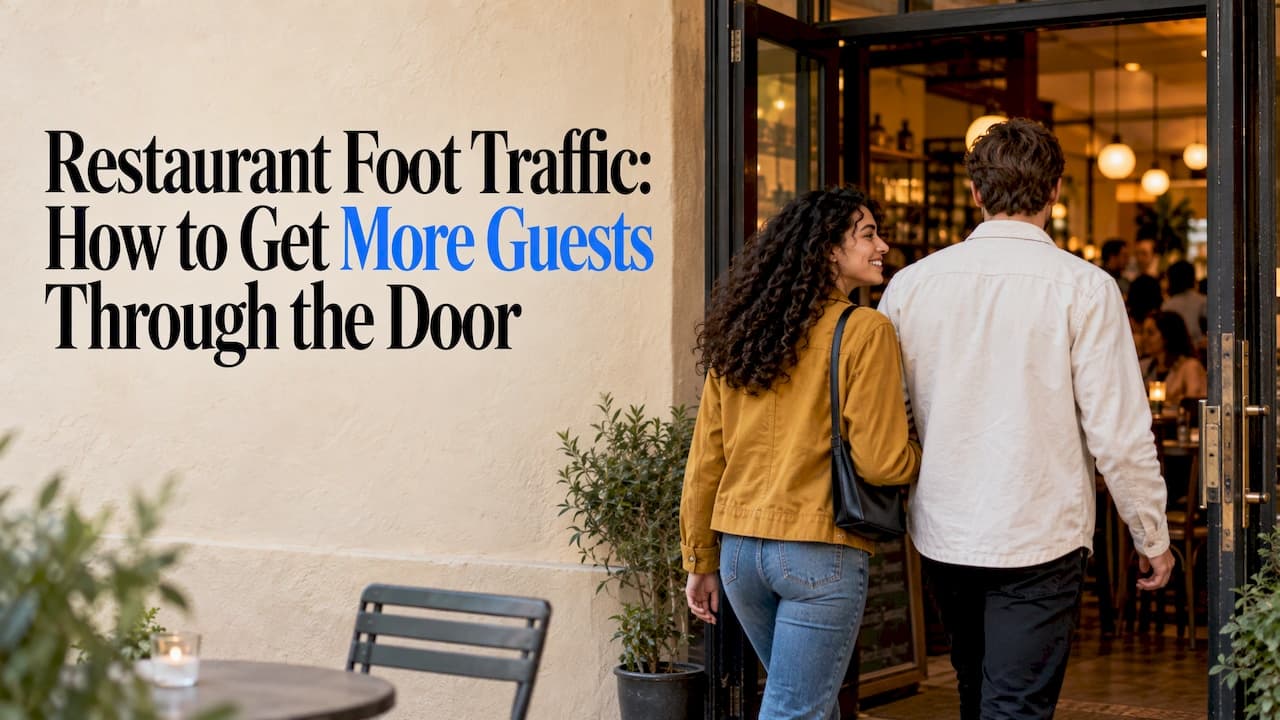
Restaurant foot traffic is the number of customers who walk in during a set period, and in the U.S. it is under pressure. In September 2026, 42% of operators reported higher traffic than a year earlier while 44% reported lower. The operators who gain ground pick their weakest day or daypart, give guests a specific reason to come, and measure the result against a fair baseline. This guide covers each step for restaurants and bars, including the question of how to increase bar traffic on slow nights.
TL;DR
- Traffic means guests (or transactions) counted the same way every period. Without a consistent count, year-over-year comparisons mean nothing.
- U.S. traffic is soft: high prices, gas costs and economic worry are keeping people home more often, so a clear value reason to visit matters.
- Fix one slow period at a time with a recurring offer or event, such as a weekday happy hour, trivia night or group package.
- Make yourself easy to find: accurate hours, mobile-friendly info, local search and discovery apps where diners already look for deals.
- Measure uplift against a comparable period, then keep, change or drop the promotion.
Table of Contents
- What restaurant foot traffic actually measures
- What the 2026 numbers say
- Start with your slowest period
- Tactics that bring guests in
- How to increase bar traffic on slow nights
- Get found by people looking for deals right now
- The Hourhunt view
- Promo: put your happy hour in front of DC diners
- Measure whether it worked
- A 30-day plan
- FAQ
- Sources
What restaurant foot traffic actually measures
Black Box Intelligence defines traffic as the number of customers visiting during a specified period. It is usually read alongside sales and average check. The catch is consistency. Limited-service businesses tend to count transactions, while full-service businesses more often count guests. A table of four is one transaction but four guests, so mixing the two methods will distort your trend line.
Pick one definition and keep it. If you use covers, always use covers. If you use checks, always use checks. That is the only way to tell whether this March beat last March.
Traffic also sits inside a simple equation. Revenue equals the number of checks times the average check, and checks equal relevant traffic times conversion rate. That is useful because it shows three separate levers: more people discovering you, more of them choosing to come in, and each of them spending a little more.
What the 2026 numbers say
The industry is growing in dollars while visits stay uneven. Inflation-adjusted sales for eating and drinking places are up, but the traffic picture is mixed. According to the National Restaurant Association's tracking, September 2026 was the 19th month with a net traffic decline in the prior 20 months.
By format, the picture differs. Placer.ai reported that in Q1 2026 fast-casual visits rose 3.1% year over year, quick-service visits were essentially flat at 0.1%, and full-service visits fell 1.4%. The same report found weekdays carried much of the momentum: fast-casual weekday visits grew 4.7% against 1.3% on weekends.
That weekday finding is good news for anyone with quiet Monday through Thursday shifts. Weekday demand is where visitors respond to a good reason to go out.
Why guests are going out less
A few forces keep showing up:
- Prices. McKinsey reported that food-away-from-home prices rose about 6% from January 2024 to September 2025, versus about 3% for groceries, which makes diners more value-conscious.
- Gas and uncertainty. Advan's September 2026 analysis tied the broad easing in restaurant traffic to high gas prices, economic uncertainty and a post-back-to-school pullback. Technomic reporting said 46% of consumers were visiting restaurants less often because of gas prices, and noted financial pressure on younger consumers in particular.
- Experience still counts. The National Restaurant Association's 2025 report found that 64% of full-service customers and 47% of limited-service customers rated the dining experience above meal price. Guests will go out when the night feels worth it.
Take both halves seriously. Guests are watching their wallets, and they still want a reason to be there. A good deal at the right hour, with a good atmosphere, answers both.
Start with your slowest period
Before you spend on any tactic, find where the empty seats are. Franki's guidance suggests pulling 90 days of POS data to identify slow days and dayparts, then targeting the single weakest period with a measurable promotion, such as a weekday happy hour, a day-specific deal or a timed lunch bundle.
A quick way to do it:
- Export 90 days of sales and covers by hour and day of week.
- Rank each day and daypart by covers, not just revenue.
- Choose the one weakest block (say, Tuesday 4 to 7 p.m. or Wednesday night).
- Write down what "better" looks like: a number of covers, not a feeling.
- Run one change for several weeks before adding another.
Focusing on one block matters because it keeps the test clean. If you launch five things at once, you will not know which one worked.
Tactics that bring guests in
The National Restaurant Association reported that 90% of fine-dining operators and 87% of casual-dining operators viewed building on-premises business as more important than off-premises growth in 2025. In the same research, 47% of operators planned to add new discounts, deals or value promotions to drive traffic. So value offers are now the norm, which means yours has to be easy to see and easy to understand.
Offers that give a reason to come in
- Happy hour on the slow block. A defined window with specific drink and food prices works because the guest knows exactly what they get and when.
- In-house-only specials. The NRA's on-premises strategies include specials available only when dining in, along with tastings, themed events and dine-in loyalty.
- Lunch specials and value bundles. Chef'Store suggests lunch specials, value bundles and limited-time seasonal menus for slow months, plus lighter dishes and zero-proof drinks.
- Neighbor partnerships. The same source suggests co-hosted happy hours and community block parties with nearby businesses.
Make the visit frictionless
The NRA also recommends local search optimization, accurate mobile-friendly websites, online reservations and waitlists, real-time table availability and text alerts when tables are ready. Most walk-in decisions are made on a phone, minutes before leaving. If your happy hour times are wrong on one listing, you lose that guest to the place down the street.
Build the atmosphere
The NRA's list covers the physical side too: cleanliness, warm lighting, varied seating and sound-dampening. A group that can talk without shouting stays longer and orders another round.
Use content and reviews
Behind-the-scenes food and drink content, customer testimonials, review requests, local-producer stories and partnerships with local bloggers or influencers are all on the NRA's recommended list. Ask happy customers for a review while they are still at the table.
How to increase bar traffic on slow nights
Bars live on routine. People return to the place that reliably has something going on.
Give the weakest night a standing event
NGAZE recommends a consistent weekly event on the weakest night, such as trivia, acoustic music or a themed cocktail night, because recurring programming gives guests a specific reason to choose you and builds a predictable traffic floor. Another industry writer makes a similar case that trivia and darts can draw crowds in ways a discount alone does not.

Treat it like a product launch. Same night, same time, same name, every week. Give it a few months before judging.
Make group bookings easy
Social groups decide together, usually over text. The same source suggests a dedicated booking page with package and capacity details, an inquiry form, an instant acknowledgement and fast follow-up. A group of eight that gets a clear answer in ten minutes books you. A group that waits a day books someone else.
Sports nights
NGAZE suggests promoting sports events 48 to 72 hours ahead, stating the viewing setup (which screens, whether sound is on), and following up with a loyalty offer so one-time game-day guests come back.
Combine events with a deal
A recurring night plus a clear happy hour price is stronger than either alone. The event is the reason to come, and the deal makes the decision easy for a price-aware guest.
Get found by people looking for deals right now
Deal-seekers search by location and time: what is cheap near me, right now. For Washington, DC and nearby areas, that is where we come in. HourHunt is a mobile app that shows nearby happy hour specials from local venues, with live notifications when new deals appear or happy hour times change. Free to use for diners, it focuses on food and drink discounts.
For a venue, a few habits make any listing work harder:
- Keep happy hour days, start and end times, and prices exactly right everywhere you appear.
- Update right away when a deal changes, such as a holiday schedule or a sold-out special.
- Be specific. "Half-price appetizers 4 to 6 p.m. Mon to Thu" beats "great deals."
- Encourage guests to confirm and review deals, since crowd-verified accuracy builds trust.
The Hourhunt view
We built HourHunt around a simple observation: people who are watching their budget still want to go out, and they decide where in the last few minutes, on a phone. The venues that win those decisions are the ones whose deals are easy to find and correct.
That is why we focus on real-time updates. A happy hour that changes at 4 p.m. and is still listed wrong at 5 p.m. costs a venue a table. Live notifications put new and changed deals in front of diners at the moment they are choosing, and crowd verification keeps listings honest.
Our advice to owners is the same as the data suggests: pick your slowest block, put a clear offer on it, make the details impossible to miss, and measure what happens. We designed the app, with its simple interface and attention to privacy, to make that discovery step effortless for diners in the DC area.
Bentley
Promo: put your happy hour in front of DC diners
If you run a bar or restaurant in the Washington, DC area, your happy hour is only as good as the number of people who know about it at the right moment. HourHunt gives nearby diners a fast way to find local specials, and alerts them when deals start or change.

See how the app works for diners and venues at HourHunt.
Measure whether it worked
A promotion that fills seats but loses money is not a win. Managerestaurant.info recommends a repeatable process:
- Define the intended outcome (more covers on Tuesdays, for instance).
- Set a comparable baseline, such as the same weekday in prior weeks.
- Measure gross sales, net sales and the value of the discounts given.
- Calculate uplift and contribution margin.
- Check for cannibalization: did guests simply shift from full-price times?
- Repeat the analysis after any change.
Franki similarly suggests comparing covers and revenue in the promotional window with a normal comparable period and dropping offers that do not return enough.
Black Box Intelligence adds that revenue moves through checks, traffic, conversion, items per check and realized price, so separate those factors. If covers rose but average check fell, the promotion drew people in but you may need a better-paired menu item. If you track mobile-device foot traffic, treat it as a directional signal: Advan cautions it should be read alongside financial data.
A simple weekly scorecard is enough:
| Metric | Before | During | Change |
|---|---|---|---|
| Covers in target block | Baseline average | Weekly count | Difference |
| Average check | Baseline | Weekly | Difference |
| Discount value given | None | Weekly total | n/a |
| Net sales in block | Baseline | Weekly | Difference |
A 30-day plan
- Week 1: Pull 90 days of data and choose your weakest block. Audit every online listing for accurate hours and deals.
- Week 2: Launch one offer or recurring event for that block. Announce it in the venue, on social and on deal-discovery listings.
- Week 3: Ask every happy guest for a review. Follow up fast on any group inquiries.
- Week 4: Compare covers, check and net sales to your baseline. Keep, tweak or end the offer, then move to the next-weakest block.
FAQ
What is restaurant foot traffic?
It is the number of customers visiting a restaurant in a given period. Operators usually count either guests or transactions, and the key is using the same method every time so comparisons are valid. It is typically read alongside sales and average check.
How can a restaurant increase foot traffic on slow days?
Find the weakest day or daypart in your POS data, then put one measurable offer on it, such as a weekday happy hour, a lunch bundle or a recurring event. Keep your hours and deals accurate online so people can find it. Compare results with a normal period before changing anything else.
How do I increase bar traffic?
Give your slowest night a standing event, such as trivia, live acoustic music or a themed cocktail night, and pair it with a clear happy hour price. Make group booking simple, and promote big games two to three days ahead. Consistency is what turns a one-off crowd into regulars.
Is restaurant traffic up or down in the U.S.?
It is mixed and leaning soft. In September 2026, more operators reported lower traffic than higher traffic, and several analysts point to high prices and economic uncertainty. Fast-casual has fared better than full-service, and weekdays have been a relative bright spot.
Sources
- Economic Indicators, National Restaurant Association
- The Placer.ai Dining Index: March 2026 Recap
- Traffic, Black Box Intelligence
- Restaurant Discounts and Promotions: How to Measure Their Economics
- Advan: Preview on Restaurants Q3 2026
- What U.S. consumers want from restaurants in 2026, McKinsey
- State of the Restaurant Industry 2025, National Restaurant Association
- State of the Restaurant Industry 2025 report (PDF)
- Technomic: Restaurants continue to struggle with traffic, Nation's Restaurant News
- 8 Strategies to Boost On-Premises Sales, National Restaurant Association
- How to increase foot traffic in restaurant, Franki
- 5 Ways to Increase Restaurant Business During Slow Months, Chef'Store
- Competitive Socializing: Why Darts and Trivia Are the New Happy Hour